How does Lumanu compare to Stripe Connect?

Connect handles payment acceptance and standard payouts well. It wasn't built to support a platform paying out thousands of 1099 creators, loan-outs, talent agencies, and international freelancers at scale. Lumanu replaces Connect on the payout side and becomes your single vendor for vendor onboarding, tax forms, payouts, compliance, and support.


our unique value

General Purpose
vs. Creator Specific

Features

Lumanu (Creator Specialist)

Stripe Connect (Generalist Payout API)

Vendor of record on the payout side

Lumanu is your single vendor for all creator payouts. You manage one vendor relationship; we manage the thousands underneath.

Your platform is the vendor managing every creator individually. Tax forms, banking, sanctions, and support obligations sit with you.

1099 filing

Lumanu is the filer of record. W-9 collection, TIN validation, 1099 e-filings, B-Notice and CP2100 response, and audit support are all on us.

Connect offers 1099 filing as a paid add-on ($2.99/IRS e-file, $1.49/state), but your platform is the filer of record. TIN mismatches, B-Notices, state withholding, and IRS-facing liability are yours.

Funding & Money Flow

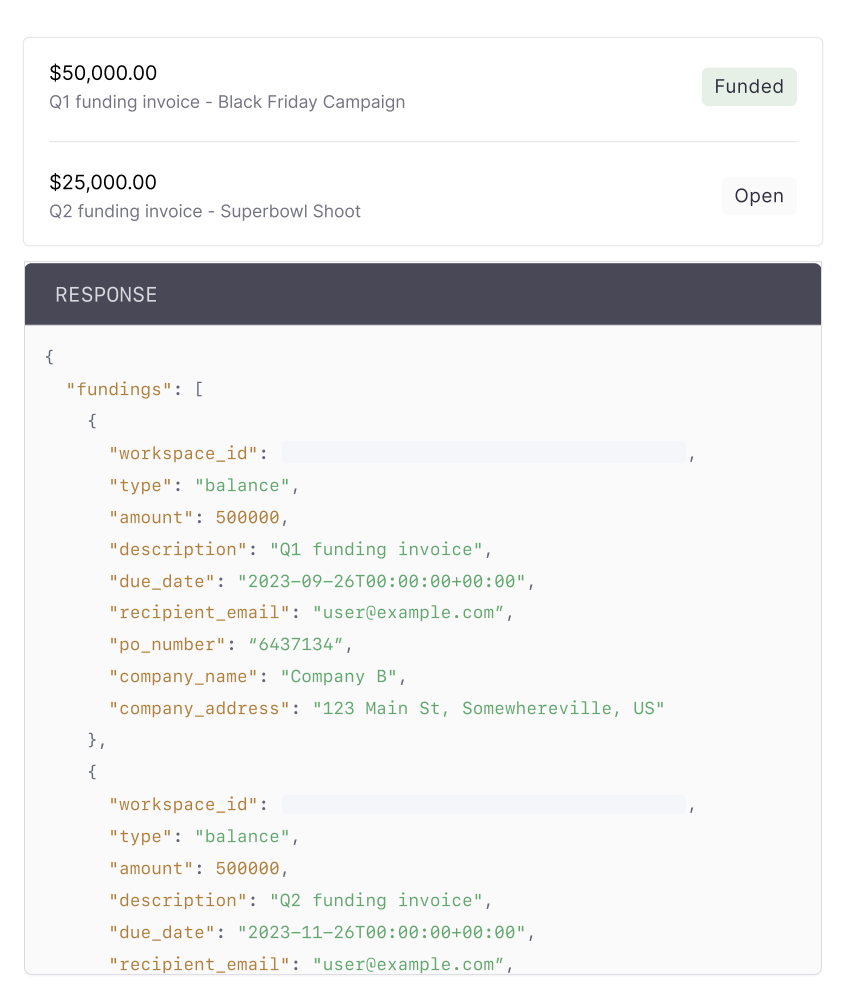
Simple Funding into a flexible wallet. Easily generate finance-ready invoices to fund dedicated Lumanu accounts. Lumanu supports platforms whether you are in or out of the money flow (MoR).

Rigid Transfer Model. Custom code is required to simulate a wallet or support lump-sum invoicing. Requires managing complex models like destination charges, separate charges and transfers, or top-ups to fund individual connected accounts.

Global Coverage & Reliability

180+ countries. Local rails where they exist, multi-bank redundancy where they don't. Creators withdraw in local currency.

Coverage exists but uneven for 1099-style payouts. Creators in several markets cannot onboard at all. FX and failure debugging are yours.

Network effect

400K+ creators already onboarded with W-9/W-8 on file. Creators who have been paid by anyone through Lumanu skip onboarding entirely.

Every creator goes through onboarding the first time they're paid on your platform or by a new paying party.

Creator Support

100% of creator tickets across onboarding, tax forms, payout failures, banking are handled by our team. White-labeled where you want it.

Connect support is for you, not your creators. Tax form errors, payout failures, and onboarding drop-offs escalate to your team.

General payment APIs

Onboarding & Compliance

Lumanu handles all vendor onboarding, compliance checks, and tax form collection.

You are responsible for building an onboarding flow and collecting and verifying W-9s/W-8BENs, and managing 1099s.

Money Flow

Flexible money flow is tailored to support your needs. Choose how your customers fund dedicated wallets.

Rigid, one-size-fits-all money flow requirements that don't adapt to your business model.

Global Payments

Fund in your customers' currencies, pay out to 180+ countries. Creators can withdraw in their local currency with local rails and cost-effective conversion rates.

Complex setup requiring regional entities (Stripe Connect) or high, often hidden, currency conversion fees passed on to recipients (PayPal).

Creator Experience

Lumanu's payment network was built to give creators a frictionless experience.

A fragmented and confusing experience for creators, who have to navigate multiple platforms and redundant information requests.

Support

White-glove support from a team of experts who understand the creator economy. We provide dedicated support to both you and your creators.

Generic support that doesn't understand the nuances of the creator economy. You and your creators are left to fend for yourselves.

One vendor, not thousands

You've built the model your customers want: one invoice, one MSA, one vendor relationship. The hard part isn't the brand side, it's what happens when you're the vendor managing tax forms, banking, and support for every creator.

Stop Managing Vendor Sprawl.

You manage one vendor relationship with Lumanu. We manage the thousands of creator tax forms, banking, sanctions screening, support.

Roadmap Protection.

Every Connect edge case from a creator in Brazil who can't onboard to 1099 correction season is tome not spent on your product.

Compliance Off Your Balance Sheet.

You're in the flow of funds, so today you're the filer of record on 1099s and on the hook for OFAC, treaty-rate withholding, and B-Notice response. With Lumanu as your vendor, that liability shifts to us..

Why Lumanu?

Where Stripe Connect leaves gaps. And how Lumanu fills them.

Stripe Connect is excellent at what it was built for, marketplace sellers. Below is what shifts when the recipient is a 1099 creator, a talent agency, a loan-out, or an international freelancer, and what changes when Lumanu owns the payments and compliance layer for your platform.

Vendor onboarding and entity complexity

The gap in StripeConnect: Connect's onboarding is built for businesses with EINs and a familiar KYC profile. For creator payouts, the recipients are individuals, sole props, loan-out companies, talent agencies. Connect models one payee per transaction. Everything else is custom logic on your team.

With Lumanu. A single onboarding API for individuals, businesses, loan-outs, agencies, and talent management arrangements. Entity-specific tax form logic built in. State management and error recovery handled by Lumanu.


Global payouts debugging

The gap in Stripe Connect: Stripe's global coverage is real for accepting payments. For creator-style payouts it's uneven. Creators in several markets can't onboard at all. Local rail availability, FX behavior, and failure modes vary. Debugging surface lands on your team every time a Brazilian Pix payment fails.

With Lumanu: 180+ countries, multi-bank redundancy, local rails where available, PayPal as a fallback, and FX creators can see. We handle creator support directly for all payouts, including global.

Enterprise funding and treasury

The gap in Stripe Connect: Connect's funding model is per-account balances and transfers, and the ACH top-up itself takes 5-6 business days to settle. Enterprise platforms collecting from brands and paying to creators want one funding event, one ledger entry, and a clean AP trail.

With Lumanu: Fund Lumanu wallets directly from your collected balance. Wires settle same day, ACH typically T+1 to T+2. The wallet has its own account and routing number. Pay Lumanu like any other vendor. Finance-ready invoicing, dedicated wallets per customer, and one AP-ready ledger.

Full tax compliance, not just collection

The gap in Stripe Connect: Connect offers 1099 filing as a paid add-on ($2.99 per IRS e-file, $1.49 per state), but your platform is the filer of record. TIN validation outcomes, B-Notice and CP2100 response, and IRS-facing liability are yours. Connect's tax product is 1099-only. No treaty rate logic, no W-8s.

With Lumanu: We are the filer of record. W-9 collection, TIN validation, W-8/BEN collection, treaty application, 1099 e-filing, B-Notice and CP2100 response, audit support.

API flow comparison

The actual API calls.
Side by side.

Most "Stripe vs. X" comparisons stop at feature checklists. Below is the actual sequence of API calls each platform requires to fund a balance, onboard a creator, and pay them from each platform's developer docs. Stripe Connect Express runs about 17 steps before a creator can be paid. Lumanu runs about 7.
Where the difference lives is what's in the diagram.

Most "Stripe vs. X" comparisons stop at feature checklists. Below is the actual sequence of API calls each platform requires to fund a balance, onboard a creator, and pay them from each platform's developer docs. Stripe Connect Express runs about 17 steps before a creator can be paid. Lumanu runs about 7.
Where the difference lives is what's in the diagram.

Lumanu vs. Stripe Connect: Creator Payouts API Comparison Stripe Connect Express requires 17 API steps to onboard and pay a creator, including a 5 to 6 business day ACH settlement wait, a requirements remediation loop where currently_due, pending_verification, and additional document requests force the creator through repeated Account Link cycles, a return_url that does not confirm onboarding is complete, and a payout failure handling path the platform owns. Lumanu requires 7 steps: fund workspace wallet via POST /funding, create payable, approve, branch on vendor network status. Settlement is same day for wires or T plus 1 to T plus 2 for ACH. Lumanu owns 1099, 1042-S, TIN matching, B-Notice response, and OFAC re-screening as the filer of record. Source: docs.stripe.com and developers.lumanu.com. stripe connect express onboarding gates payment · 17 steps lumanu payment drives onboarding · 7 steps 01 Fund Stripe balance via ACH top-up · US platforms 02 · wait state 5–6 business days for ACH to settle source: docs.stripe.com 03 POST /v1/accounts create connected vendor account 04 Stripe returns vendor account requirements hash: currently_due, pending_verification 05 POST /v1/account_links generate vendor onboarding URL 06 Redirect creator to Stripe-hosted onboarding URL 07 Creator submits ID, bank, ToS to Stripe directly 08 · footgun return_url ≠ onboarding complete platform must verify via webhook 09 account.updated webhook fires to platform 10 GET /v1/accounts/{id} parse requirements hash 11 · remediation loop currently_due not empty → new Account Link pending_verification → poll, wait, retry extra docs → new Account Link, restart per platform · per creator · every time 12 payouts_enabled = true platform may now transfer 13 POST /v1/transfers amount, currency, destination 14 Stripe credits connected account balance 15 Auto-payout on schedule daily rolling default · or POST /v1/payouts 16 Stripe initiates payout to creator's bank 17 · failure path payout.failed → platform owns it debug failure reason contact creator fix bank info · re-initiate 01 Fund workspace wallet POST /funding · method: balance 02 · settlement Same day (wire) or T+1 to T+2 (ACH) wallet has account/routing for direct AP transfer 03 POST /payable workspace_id, payee, amount vendor status doesn't matter 04 POST /payable/{id}/approve draws from wallet balance supports reviewer workflows 05 · branch Vendor in Lumanu network? yes no in network Lumanu credits vendor wallet immediately. Lumanu invites vendor via email. Creator submits TIN + bank info. Support handles any questions. 06 Funds in vendor wallet held pending verification if needed released automatically on verify 07 · handoff Platform stops being involved vendor handles withdrawal directly

The Stripe side is sourced from docs.stripe.com. The Lumanu side is from developers.lumanu.com. Every box maps to the API call you'd write.

FAQ

FAQ

Your top questions, answered

Your top questions, answered

What does Stripe Connect not do for creator payouts?

Stripe Connect was built for marketplace sellers, not 1099 creators and freelancers. The gaps platforms most commonly hit at scale are:

  • W-8 collection for non-US payees. Connect collects basic tax info but does not run the W-8BEN / W-8BEN-E lifecycle.

  • Ongoing OFAC and sanctions screening. Connect screens its own KYC. Continuous monitoring of who you're paying is your responsibility.

  • Creator-facing support. Connect support is for the platform, not for creators. Tax form errors, payout failures, and onboarding drop-offs escalate to your team.

  • Global coverage for individual creators. Coverage is real for accepting payments. For 1099-style payouts to individuals, creators in several markets cannot onboard at all.

Do I replace Stripe Connect with Lumanu, or run them together?

For creator and freelance payouts, Lumanu replaces Stripe Connect.

The full payout stack moves to Lumanu: vendor onboarding, tax forms, payouts, compliance, and support.

Platforms that also use Stripe Payments for card acceptance from brands or end customers can continue to run that flow on Stripe; Lumanu and Stripe Payments are not in conflict.

The replacement is specifically Connect's payouts and connected-accounts surface.

Does Stripe Connect file 1099s for my platform?

Stripe Connect offers 1099 filing as a paid product (currently $2.99 per 1099 e-filed with the IRS, plus $1.49 per state filing), but your platform is the filer of record. That means you own TIN validation outcomes, B-Notice and CP2100 response, state withholding logic, and the legal exposure if a form is filed incorrectly.

Connect's product covers 1099-NEC, 1099-MISC, and 1099-K. It does not cover tax treaty rate application, W-8BEN logic, or 1099 corrections at scale.

Lumanu acts as the vendor of record on the payout side and the filer of record on tax forms. The IRS-facing liability moves to us.

What's the difference between Lumanu and Tipalti, Trolley, or Hyperwallet?

Tipalti, Trolley, and Hyperwallet are payout engines. They move money, collect tax forms, and offer reporting. Your platform remains the vendor of record on the payout side, and creators remain individual vendor relationships on your books.

Lumanu becomes your single vendor for payouts. Your creators sit inside our network with tax forms already on file, we own the regulator-facing compliance work end-to-end, and the vendor-of-record posture for thousands of payees consolidates to us. If 1099 season eats your finance team alive, if creator support tickets are eating your operations team, or if your engineering team is shipping payment exceptions instead of product, that's the gap a payout engine doesn't close.

For a platform with low volume and minimal compliance needs, a payout engine can be a reasonable fit. They're good at what they do; they just solve a narrower problem.

How long does it take to integrate Lumanu?

Most platforms are in production within 4-8 weeks depending on scope. A REST API integration with basic creator onboarding and payouts can ship in two to three weeks. Adding custom funding flows or embedded onboarding components typically extends the timeline to four to six weeks. A solutions engineer works with your team from sandbox access through go-live.

How does Lumanu work for platforms that are in the flow of funds?

Lumanu is designed for in-flow platforms. The platform stays in the money flow with its enterprise customers and funds Lumanu directly from its own collected balance.

Lumanu becomes the platform's single vendor for payouts: we own vendor onboarding, tax forms, compliance, payout execution, and creator support, while the platform stays the vendor of record to its brand customers. The platform's regulator-facing exposure on the payout side (1099 filing, OFAC screening, B-Notice response) moves to Lumanu.

Out-of-flow models are supported as well for platforms that prefer to stay outside the money flow entirely; in that setup, the brand funds Lumanu directly and Lumanu acts as both vendor of record and merchant of record.

Platforms can also elect to run a hybrid model, depending on your customer needs.

What does Lumanu own that my platform would otherwise own?

Lumanu owns the full vendor-of-record and tax compliance layer on the payout side. Specifically:

  • Tax forms: W-9 collection and TIN validation, W-8BEN and W-8BEN-E collection, 1099 e-filing, B-Notice and CP2100 response, audit support.

  • Compliance: OFAC and sanctions screening, beneficial ownership collection for entity payees, KYC and KYB.

  • Payment execution: Multi-bank redundancy, local rails where available, FX, payout retries, failure recovery, Visa direct push to card and PayPal options.

  • Entity complexity: Native handling of individuals, sole props, single-member LLCs, loan-out companies, agency-of-record arrangements, talent management splits, and SAG-AFTRA payments.

  • Support: 100% of creator support (onboarding, tax forms, payout failures, banking issues), handled by our team. White-labeled where you want it.

The regulator-facing liability for these items moves to Lumanu.

What does Stripe Connect not do for creator payouts?

Stripe Connect was built for marketplace sellers, not 1099 creators and freelancers. The gaps platforms most commonly hit at scale are:

  • W-8 collection for non-US payees. Connect collects basic tax info but does not run the W-8BEN / W-8BEN-E lifecycle.

  • Ongoing OFAC and sanctions screening. Connect screens its own KYC. Continuous monitoring of who you're paying is your responsibility.

  • Creator-facing support. Connect support is for the platform, not for creators. Tax form errors, payout failures, and onboarding drop-offs escalate to your team.

  • Global coverage for individual creators. Coverage is real for accepting payments. For 1099-style payouts to individuals, creators in several markets cannot onboard at all.

Do I replace Stripe Connect with Lumanu, or run them together?

For creator and freelance payouts, Lumanu replaces Stripe Connect.

The full payout stack moves to Lumanu: vendor onboarding, tax forms, payouts, compliance, and support.

Platforms that also use Stripe Payments for card acceptance from brands or end customers can continue to run that flow on Stripe; Lumanu and Stripe Payments are not in conflict.

The replacement is specifically Connect's payouts and connected-accounts surface.

Does Stripe Connect file 1099s for my platform?

Stripe Connect offers 1099 filing as a paid product (currently $2.99 per 1099 e-filed with the IRS, plus $1.49 per state filing), but your platform is the filer of record. That means you own TIN validation outcomes, B-Notice and CP2100 response, state withholding logic, and the legal exposure if a form is filed incorrectly.

Connect's product covers 1099-NEC, 1099-MISC, and 1099-K. It does not cover tax treaty rate application, W-8BEN logic, or 1099 corrections at scale.

Lumanu acts as the vendor of record on the payout side and the filer of record on tax forms. The IRS-facing liability moves to us.

What's the difference between Lumanu and Tipalti, Trolley, or Hyperwallet?

Tipalti, Trolley, and Hyperwallet are payout engines. They move money, collect tax forms, and offer reporting. Your platform remains the vendor of record on the payout side, and creators remain individual vendor relationships on your books.

Lumanu becomes your single vendor for payouts. Your creators sit inside our network with tax forms already on file, we own the regulator-facing compliance work end-to-end, and the vendor-of-record posture for thousands of payees consolidates to us. If 1099 season eats your finance team alive, if creator support tickets are eating your operations team, or if your engineering team is shipping payment exceptions instead of product, that's the gap a payout engine doesn't close.

For a platform with low volume and minimal compliance needs, a payout engine can be a reasonable fit. They're good at what they do; they just solve a narrower problem.

How long does it take to integrate Lumanu?

Most platforms are in production within 4-8 weeks depending on scope. A REST API integration with basic creator onboarding and payouts can ship in two to three weeks. Adding custom funding flows or embedded onboarding components typically extends the timeline to four to six weeks. A solutions engineer works with your team from sandbox access through go-live.

How does Lumanu work for platforms that are in the flow of funds?

Lumanu is designed for in-flow platforms. The platform stays in the money flow with its enterprise customers and funds Lumanu directly from its own collected balance.

Lumanu becomes the platform's single vendor for payouts: we own vendor onboarding, tax forms, compliance, payout execution, and creator support, while the platform stays the vendor of record to its brand customers. The platform's regulator-facing exposure on the payout side (1099 filing, OFAC screening, B-Notice response) moves to Lumanu.

Out-of-flow models are supported as well for platforms that prefer to stay outside the money flow entirely; in that setup, the brand funds Lumanu directly and Lumanu acts as both vendor of record and merchant of record.

Platforms can also elect to run a hybrid model, depending on your customer needs.

What does Lumanu own that my platform would otherwise own?

Lumanu owns the full vendor-of-record and tax compliance layer on the payout side. Specifically:

  • Tax forms: W-9 collection and TIN validation, W-8BEN and W-8BEN-E collection, 1099 e-filing, B-Notice and CP2100 response, audit support.

  • Compliance: OFAC and sanctions screening, beneficial ownership collection for entity payees, KYC and KYB.

  • Payment execution: Multi-bank redundancy, local rails where available, FX, payout retries, failure recovery, Visa direct push to card and PayPal options.

  • Entity complexity: Native handling of individuals, sole props, single-member LLCs, loan-out companies, agency-of-record arrangements, talent management splits, and SAG-AFTRA payments.

  • Support: 100% of creator support (onboarding, tax forms, payout failures, banking issues), handled by our team. White-labeled where you want it.

The regulator-facing liability for these items moves to Lumanu.

Ready to Grow Your Platform's Payment Adoption?

Stop worrying about payments and start scaling your business.