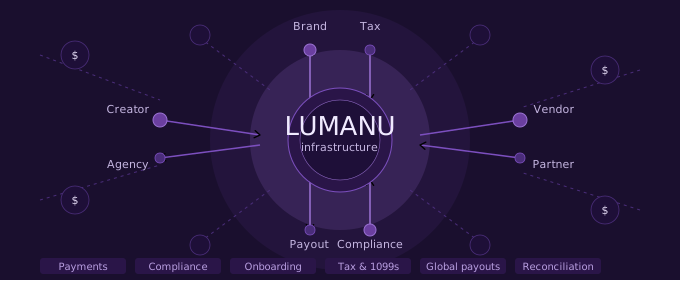
Top 5 Payment API Solutions for Influencer & Affiliate Platforms: The Complete 2026 Guide
Comparing Stripe vs. Lumanu vs. Tipalti for creator payouts? Discover the best payment infrastructure to reduce engineering lift, automate 1099s, and shield your platform from compliance liability.

Paul Johnson

12
/
17
/
2025
Solution | Primary Value | Compliance Level | Integration Effort | Best 2026 Use Case |
Lumanu | Risk/Operational overhead reduction | Total (Master Vendor) | Low | Influencer Marketing Platforms & Marketplaces |
Stripe | Product Flexibility | Modular (Self-Managed) | High | Custom Marketplace Logic |
Tipalti | Finance Control | High (Corporate AP) | Medium/High | Enterprise ERP Sync |
PayPal | Global Reach | Minimal | Low | Global Micro-payouts |
Wise | FX Efficiency | None (Money Move) | Medium | Cross-border cost saving |
Who's This Guide For?
This guide is specifically written for the Founder, CTO, or Head of Finance of:
Influencer Marketing Platforms (IMPs) and Marketplaces
Affiliate Network and Partner Program Platforms
Vertical SaaS Solutions that facilitate payouts to creators, freelancers, and large vendor networks.
If you are tasked with making a critical technology decision on payment infrastructure, minimizing engineering lift, reducing compliance risk, and lowering your total cost of operations for global payouts, this is your essential reading.
If your primary goal is... | Recommended Solution | Rationale |
Offloading Vendor Onboarding and Compliance | Lumanu | Best for platforms that want to outsource 1099s, KYC, and support entirely via a Master Vendor model. |
Bespoke Product Flow | Stripe Connect | Best for engineering-heavy teams building unique, multi-party checkout-to-payout experiences. |
Mass Global Reach (No Bank Info) | PayPal Payouts | Best for micro-payouts where the recipient's email is the only available data point. |
Complex Enterprise Treasury | Tipalti | Best for mature finance teams needing deep ERP sync (NetSuite/Oracle) for global AP. |
Pure FX Cost Optimization | Wise | Best for simple, high-volume international transfers where compliance is handled elsewhere. |
Table of Contents
The Critical Challenge of Influencer Payments
Why payments are a complex operational challenge and an introduction to the top influencer payment solutions for 2026.
The True Cost of Payment Infrastructure
The Strategic Advantage of Modern Solutions with an analysis into the hidden costs of general payout solutions (Engineering Lift, Compliance, FX).
Essential Capabilities: What to Evaluate
The core considerations: Compliance, Tax Management & Liability (1099s, KYB/KYC), Funding, Pay-Out Methods, Global Reach, Security, Certifications (SOC 2), and Integration Needs.
In-Depth Platform Analysis: The Top 5 Solutions
Lumanu: The Payments Master Vendor Solution (Master Vendor Model).
Stripe Connect: The Developer's Toolkit (Customizability vs. Liability).
Tipalti: The AP Automation Giant (Enterprise Finance Focus).
PayPal Payouts: The "Consumer" Wallet (Global Wallet Reach).
Wise: The International Specialist (Best FX Rates).
Operational Comparison: Total Cost & Engineering Lift
Feature comparison table and deeper analysis of hidden costs.
The Lumanu Advantage: Wallet Architecture & Liability Shield
Why the "Master Vendor" and "Wallet" models significantly reduce risk and support for "In the Flow" vs. "Out of the Flow" funds management.
Implementation, Best Practices, and Framework
How to minimize time to market and engineering investment using a decision matrix approach with assessment criteria.
Frequently Asked Questions (FAQ)
Conclusion
Managing payments to influencers and affiliates has become one of the most complex operational challenges facing platforms and marketplaces. Payments are a critical part of workflows for influencer campaigns and affiliate programs. Platforms supporting in this space need to find the right solution to support continued growth while solving for vendor onboarding, compliance, tax, handling potential error states, and importantly minimizing engineering lift and support costs.
In 2026, the top payment platforms to support payouts for platforms include: Lumanu, Wise, Stripe Connect, Tipalti, and PayPal Payouts.
The best payment solutions combine robust compliance features including automated 1099 handling, global pay-in and pay-out capabilities, enterprise-grade security certifications, and transactional fees that scale with usage.
This comprehensive guide examines the leading payment solutions to support influencer & affiliate payouts, and analyzes their features, costs, compliance capabilities, and suitability for different scenarios. Understanding these platform differences is important to make the best decision for managing payments at scale and ensuring regulatory compliance.
Why Choosing the Right Payment Solution for your Influencer & Affiliate Platform Matters
The creator and affiliate payment landscape has evolved. It is easy to send money, but paying individuals at scale introduces friction around:
KYC/KYB: Verifying identities to prevent fraud.
Tax Compliance: Managing the mix of W-9s, W-8BENs, 1099-NECs, and 1099-Ks.
Support Costs: Dealing with "Where is my money?" tickets.
Operational Costs: Managing error states during vendor onboarding, fund transfers, INTL payouts, etc.
The Hidden Costs of Generic Payment Infrastructure
Companies using overly generic or inadequate payment systems often encounter “hidden” expenses that can increase the total cost of ownership
These include:
Engineering Lift: Building role based access controls, funding (invoicing), support for INTL payments, UI for onboarding, and handling various error states.
Support costs: Tracking down payment statuses, updating vendor records and reconciling payouts can lead to hours of time spent across teams
Compliance penalties: IRS fines for improper 1099 reporting can reach $50-$280 per form
Administrative overhead: Manual vendor onboarding and payment processing can result in hidden costs of $700-$1000 per vendor
Foreign exchange losses: Poor FX rates can add 3-7% to international payments
The Strategic Advantage of Modern Payment Solutions
Leading solutions have transformed from simple payment processors into comprehensive solutions that include compliance and support. They offer:
Intuitive vendor onboarding and self service account management
Automated compliance workflows that reduce legal risk
Streamlined implementation that minimize engineering investment
Support for platforms who are “in” or “out” of the money flow
Built in capabilities to easily manage account funding
Integrated reporting that simplifies financial reconciliation
Global payment capabilities that enable international partnerships and payments from various source currencies
Key Capabilities to Evaluate for Payment Solutions
Compliance and Tax Management
Modern businesses require platforms that handle the complex regulatory landscape automatically. Essential compliance features include:
Automated 1099 Generation: Platforms should automatically generate, distribute, and file 1099-NEC forms for U.S. vendors earning over $600 annually. This eliminates manual tracking and reduces filing errors.
International Tax Compliance: For global operations, platforms must navigate varying tax treaties, withholding requirements, and reporting obligations across different jurisdictions.
Lightweight KYB/ KYC: Ensure that you are paying who you think you are paying and that the individual or business is not on any sanctions list (AML/ OFAC screening). Optional checks for adverse media and brand safety.
“Pay-in” Account funding and management
The ability to easily fund account(s) in different currencies and the ability to run reconciliation. Leading platforms support:
Process to fund accounts from platform funds or directly from platform customers
Configurable and compliant invoicing to support AP workflows (customizable based on AP requirements)
Segregated funds in dedicated accounts with running balance and full ledger
Team level budgets and workflows to support companies with different budgets (e.g. influencer, affiliate, social teams)
“Pay-Out” Methods and Global Reach
The ability to pay vendors through their preferred methods significantly impacts satisfaction and retention. Leading platforms support:
Bank transfers in 100+ countries
Local to local payments to reduce fees
Digital wallets including PayPal payouts
Push to card payouts for instant payouts
Security and Certifications
Enterprise-grade security is non-negotiable when handling vendor payments and sensitive business data. Look for platforms with:
SOC 2 Type II certification for operational security controls
ISO 27001 compliance for information security management
Bank-level encryption for data transmission and storage
GDPR compliance for payouts across the EU
Integration Capabilities
Modern payment platforms must integrate seamlessly with existing business systems to maximize efficiency. Key integration features include:
API access for custom workflow automation
Easy vendor onboarding without the need to manage states and errors
Project management tools like custom built platforms, Asana, Airtable, Monday.com
Web hooks to support CRM for unified vendor relationship management
Accounting software integration with QuickBooks, Xero, and NetSuite
Client and Payee Support
Dedicated support teams to handle any potential time sensitive issues that come up. Look for platforms with:
Pre-sales support to help drive adoption of payments and “stickiness” for your platform
Commitment to your platform to address product enhancements and needs
Ongoing dedicated support for your customers and influencer & affiliates
Direct banking relationships to quickly investigate and resolve any banking issues
Detailed Analysis: The Top 6 Payment Solutions for Influencer & Affiliate Platforms
1. Lumanu: The Master Vendor & Liability Specialist
Lumanu is a purpose-built orchestration layer for the creator economy. Unlike traditional processors, Lumanu operates as a Master Vendor. This means the platform sits between the payer and the thousands of creators, absorbing the administrative and legal burden of the relationship.
Best For: Platforms and Marketplaces that want to offload the "back-office" of payments (1099s, KYC, support) to focus entirely on their core product.
Strategic Advantage: By using a "Wallet" architecture, Lumanu allows platforms to trigger payments without necessarily being the "custodian" of funds, which simplifies the regulatory path for many startups.
The Trade-off: Because Lumanu handles the onboarding flow to ensure compliance, platforms have slightly less control over the "pixel-perfect" UI customization compared to a raw API like Stripe.
2. Stripe Connect: The Infrastructure Standard
Stripe Connect is a sophisticated toolkit of APIs designed for engineering-heavy teams. It allows for nearly infinite complexity in how money moves between multiple parties.
Best For: Product teams building unique financial flows (e.g., instant split-payments between an influencer, their agency, and a charity) who have the DevOps resources to maintain it.
Strategic Advantage: Unrivaled documentation and the ability to integrate payment acceptance (Pay-in) and payouts in a single dashboard.
The Trade-off: High "Total Cost of Ownership." Stripe provides the bricks, but you must build the house. This includes managing 1099 filing states, handling banking errors, and paying separate fees for identity verification and tax tools.
3. Tipalti: The Enterprise AP Heavyweight
Tipalti is an Accounts Payable (AP) automation giant designed for corporate finance departments that prioritize "control" and ERP synchronization above all else.
Best For: Mature, high-volume enterprises that treat influencers like traditional corporate vendors and require 2-way sync with NetSuite, Oracle, or SAP.
Strategic Advantage: Extreme reliability for massive global batches and robust fraud detection protocols that satisfy mid-market and enterprise audit requirements.
The Trade-off: The "Creator Experience" is often secondary. The onboarding portal can feel cumbersome for mobile-first influencers, leading to higher support tickets for the platform’s ops team.
4. PayPal Payouts: The Ubiquity Play
PayPal remains the "default" for many due to its massive global footprint and the fact that most creators already have an account.
Best For: Early-stage experiments or micro-payment use cases where the recipient’s email address is the only piece of data you want to collect.
Strategic Advantage: Instant global reach without needing the recipient's bank routing or IBAN numbers.
The Trade-off: High "Hidden" costs. PayPal often captures significant margin on FX spreads (3-7%). Additionally, the risk of "account freezes" remains a persistent concern for businesses scaling quickly.
5. Wise: The FX Utility
Wise (formerly TransferWise) is built for one thing: moving money internationally at the lowest possible currency conversion cost.
Best For: Platforms that already have their own compliance and tax infrastructure and simply need a "dumb pipe" to move money globally at mid-market rates.
Strategic Advantage: The most transparent pricing in the industry for cross-border transfers.
The Trade-off: Minimal compliance support. Wise does not collect W-9s, generate 1099s, or provide the "Master Vendor" liability shield that specialized platforms offer.
Operational Comparison: Capabilities & Engineering Lift
Instead of looking at just transaction fees—which can be misleading—founders should look at the Total Cost of Operations.
Feature / Capability | Lumanu | PayPal Payouts | Stripe Connect | Tipalti | Wise |
Vendor onboarding and compliance | Yes. Fully handles out of the box and takes on all compliance | No | Yes. Gives you the building blocks to setup onboarding and compliance. Platform must manage all states. | Yes. Provides rigid onboarding flow. Your platform must manage support. | No |
Tax Filing | Lumanu files 1099 | PayPal files 1099-K | Platform files (via Stripe Tax) | Platform files | Platform files |
Liability Shield | High (Lumanu is legal vendor) | Medium (PayPal owns K, you own relationship) | Low | Low | Low |
Creator Experience | Seamless and unified. Purpose built for creators | PayPal experience | Mixed (must have Stripe account) | Enterprise grade but difficult | Standard |
Engineering Lift | Low | Low (Simple API) | High (Custom Build) | Medium/High | Medium |
Pricing Model | Simple, All-in transaction based pricing | Tx Fee + FX + Spread | Complex (Per cap + %) | High SaaS + Tx | SaaS + Tx + FX |
Hidden Costs to Consider
Compliance Management: Manual 1099 preparation and filing can cost $25-$50 per form when outsourced to accounting firms. Platforms with automated compliance can save thousands annually for businesses with large vendor networks.
Foreign Exchange Margins: Traditional banks and some payment platforms add 2-5% margins to currency conversions. Over time, these margins can exceed transaction fees for international payments.
Administrative Overhead: Manual vendor onboarding, payment processing, and record-keeping can consume 2-5 hours per vendor monthly. Automated platforms reduce this to minutes, representing significant labor cost savings.
Integration and Setup Costs: While some platforms offer free setup, enterprise implementations may require custom integration work costing $10,000-$50,000 for complex workflows.
Exception Handling: When payments fail, a certain country is not available to send funds to, or vendors enter incorrect banking details, the true time and cost to resolve the issue can take hours of time and context switching across the team. Manual error state management, including handling failed webhooks, rejected ACH/wire transfers, and banking delays, consumes valuable engineering time and can lead to frustrated customers and influencers.
Support Costs: High volumes of "Where is my money?" tickets due to payment delays, FX confusion, or clunky vendor portals create a heavy burden. Dealing with payment status inquiries, updating vendor records, and manual reconciliation can consume hours of time across customer support and finance teams, significantly increasing your overall Total Cost of Operations. Platforms with dedicated vendor support and seamless user experiences can reduce these support tickets drastically.
Fraud risk: There has been a spike in hacked email accounts of influencers and affiliates with bad actors attempting to divert funds paid by platforms to different bank accounts. Platforms with strong ID verification onboarding flows, 2FA and other security measure (e.g. IP monitoring) can help protect against siphoned funds.
Why Lumanu is Different
1) The "Master Vendor" Advantage
Most platforms (Stripe, Wise, Tipalti) function as Software & Rails. You are still the legal merchant for every creator you pay. This means:
Liability: If a creator is on a sanctions list (OFAC), you are liable.
Support: When a bank transfer fails, your team has to debug it.
Tax: You are responsible for the accuracy of every W-9.
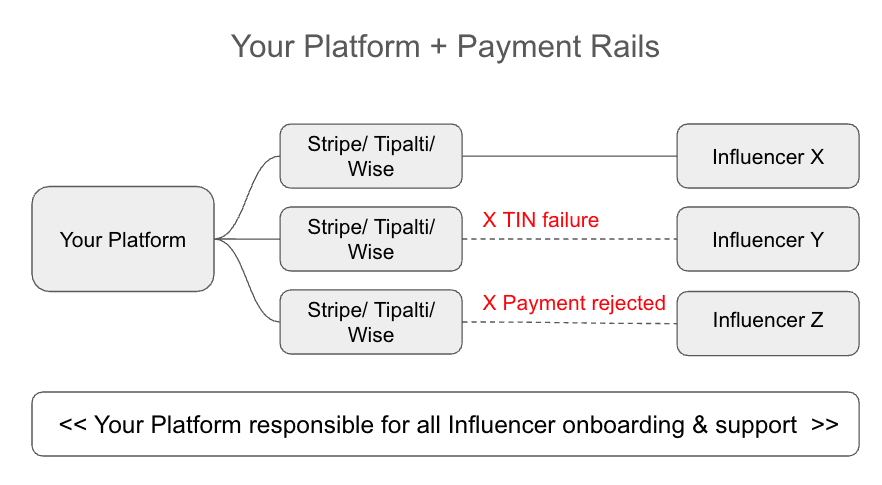
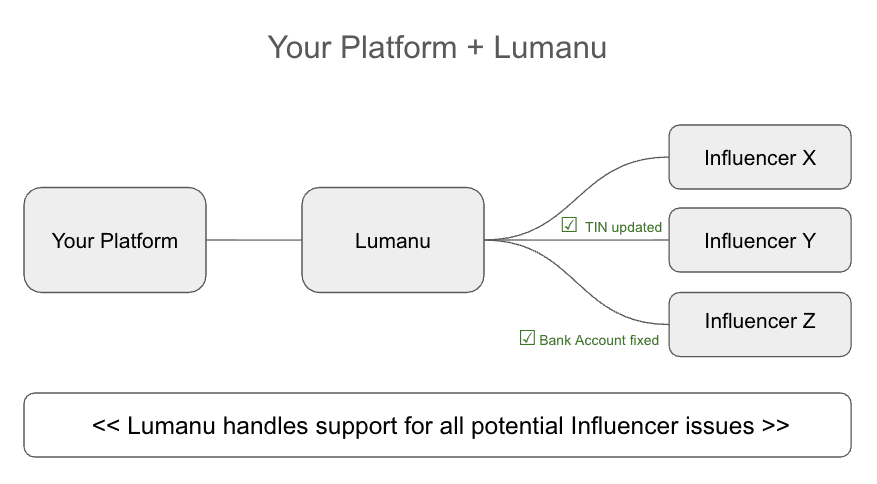
Lumanu acts as your Single Vendor. When you pay through Lumanu, you pay Lumanu. We then distribute funds to the creators.
For Finance: You deal with 1 vendor instead of 10,000.
For Tech: You integrate one endpoint. We handle the banking error states, the KYC failures, and the tax data updates.
For Creators: They get a single, clean 1099 at the end of the year.
2) The "Wallet Advantage"
One underestimated challenge in building a payout capability is Ledgering. If you use a traditional processor or AP solution (Stripe Connect, Wise, Tipalti, PayPal) your platform is responsible for tracking every penny. You must build a system that manages: "Customer A has $50 pending, $10 available, and $5 in transit."
The Risk: If your internal ledger falls out of sync with the actual bank balance (due to a failed web hook, a refund, or a currency fluctuation), you are liable for the difference.
The Lumanu Solution: Lumanu provides a Creator Wallet architecture. We act as the ledger. You simply instruct us to "Pay Creator A $500," and the funds move into their Lumanu Wallet.
Flexible Funds Flow: In or Out? Because Lumanu uses this Wallet architecture, we support flexible workflows that other providers cannot:
In the Flow of Funds: You fund your Platform Lumanu Master Account Wallet as needed with bank transfers and compliant invoicing (often aligning with your customer funds). You then API-trigger payouts to thousands of Creator Wallets instantly. Lumanu supports custom fields to easily track payouts by customer ID and campaign.
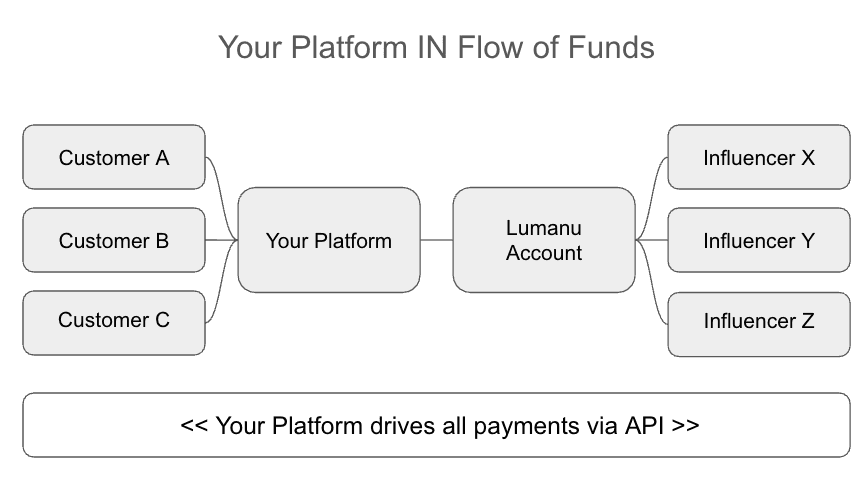
Out of the Flow of Funds: You can have your brands or third parties pay Lumanu directly, each to a unique and segregated bank account. Your platform supports creating funding requests for your customers to “top off” funds. You never touch the money, removing you from the flow of funds entirely and significantly reducing your regulatory burden. Your platform manages payout workflow across your customers via dedicated supporting Lumanu accounts.
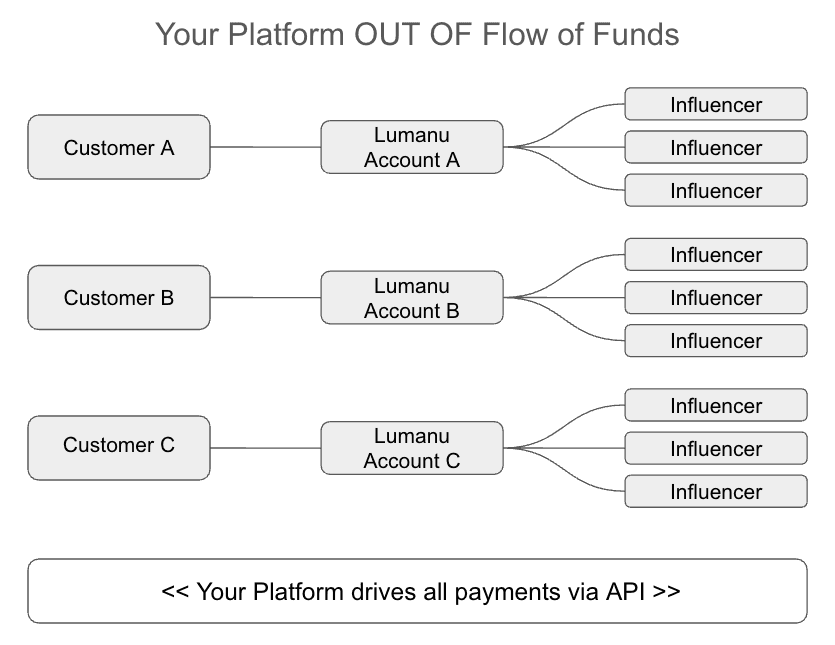
Why this matters: With Stripe, "holding" funds requires complex escrow licenses or "FBO" (For Benefit Of) accounts. With Lumanu, the money sits in the User's Wallet, not your platform's balance sheet.
Implementation Best Practices: Minimizing Time to Market and Implementation Engineering resources
Successful influencer payment platform implementation requires planning and attention to operational details that can significantly reduce time to market and potential decisions that lead to ongoing support costs.
Integration Planning
System Mapping: Document existing systems that need to integrate with the payment platform along with data flows. Include your platform along with any external systems like accounting software or project management tools.
Joint API Integration Plan: Work with your chosen partner to develop a shared integration plan along with open communication channels (e.g. Slack). Define clear deliverables and phases to move from design to sandbox to production.
Workflow Automation and Complexity Reduction: Identify opportunities to automate current manual processes through platform features and API integrations. Where possible reduce steps and complications from your existing process.
Onboarding Strategy
Phased Rollout: Implement the platform with a test campaign or customer first to identify and resolve issues before full deployment.
Training Programs: Provide training for internal teams (and potentially creators depending on onboarding flow) to ensure smooth adoption and minimize support requests.
Communication Planning: Develop clear communication about the transition, including timelines, benefits, and support resources.
Performance Monitoring
Key Metrics Tracking: Monitor payment processing times and late payments, vendor satisfaction scores, compliance accuracy, and cost per transaction.
Regular Reviews: Conduct quarterly reviews of platform performance against business objectives and vendor feedback.
Optimization Opportunities: Continuously identify ways to improve workflows and reduce costs through platform feature utilization.
Making the Right Choice: Platform Selection Framework
Selecting the optimal freelance payment platform requires a systematic evaluation of your specific business needs, constraints, and growth objectives.
Assessment Criteria
Payment Volume and Frequency: High-volume operations may benefit from platforms offering volume discounts.
Geographic Distribution: Businesses with concentrated regional vendor bases may prioritize platforms with strong local capabilities over global reach. Ensure that each region can be supported via siloed workspaces.
Integration Needs: Companies with sophisticated technology stacks require platforms with comprehensive API capabilities and pre-built integrations.
Growth Trajectory: Consider platforms that can scale with your business and add features as your needs evolve. Ability to influence the roadmap can go a long way to future proofing your business.
Client type: If your clients who pay you are enterprises, agencies, brands, consumers, etc impact who you should pick. For example if your clients are enterprise brands and agencies who need more robust controls, you will have to build that yourself because some payment tools like Stripe and PayPal and Tipalti do not support robust controls and separation of funds.
Decision Matrix Approach
Create a weighted scoring system that reflects your priorities:
Cost Structure (Weight: 20%): Total cost of ownership including fees, implementation, and administrative savings
Compliance Capabilities (Weight: 20%): Automation level, accuracy, and coverage of regulatory requirements
User Experience (Weight: 20%): Ease of use for both internal teams and vendors
Integration Capabilities (Weight: 10%): These are table stakes but API quality, pre-built integrations, and customization options should meet your requirements
Support and Reliability (Weight: 30%): Customer service quality, uptime, and issue resolution speed. Ensuring your partner can handle front line support when dealing with a large volume of influencer payouts is crucial, as is ensuring your payment infrastructure will b e available when your customers need it.
Frequently Asked Questions
What is the best way for platforms to manage influencer payouts?
The best method depends on your business size and needs, but leading platforms like Lumanu, Stripe Connect and Tipaliti offer secure, compliant solutions with global reach and varying degrees of tax compliance support.
Which payment solution is best for platforms paying international influencers?
Wise and PayPal excel at international payments with competitive exchange rates and broad global coverage, while Lumanu offers superior compliance automation for enterprise clients with international vendor networks.
Does a "Wallet" infrastructure help me if I want to avoid holding funds as a platform?
Yes, it is the best solution for that. Many marketplaces want to trigger payments without actually taking possession of the funds. Because Lumanu assigns a real, functional wallet to every customer and creator, you can route payments from your customers directly to creators. The funds land in your customer’s wallet which is a dedicated bank account, not a sub-account on your books. This allows you to orchestrate the transaction without being the custodian of the cash.
How do influencer payment solutions handle tax and compliance for platforms?
Most modern platforms help collect and validate information and assist with automatic 1099 generation for U.S. vendors. They also may handle international tax withholding requirements, and maintain documentation for compliance audits. If you work with a solution like Lumanu who is a master vendor, the solution will take all on all tax compliance so that you do not have to.
Are there payment solutions with low fees for influencers?
Wise offers the lowest fees for international transfers using mid-market exchange rates, while enterprise platforms like Lumanu do not charge fees to influencers and provide custom pricing that can be more cost-effective for high-volume operations.
What is the safest way to pay influencers via a payment solution?
Use platforms with SOC 2 Type II certification, bank-level encryption, and comprehensive insurance coverage. Lumanu, and other enterprise-grade platforms offer the highest security standards for business payments.
Conclusion: Choosing Your Ideal Influencer Payment Platform
The payment platform you choose to manage your influencer payouts will significantly impact your operational efficiency and ultimately your customer relationships. While cost considerations are very important, the total value equation must include compliance automation, security features, support, integration capabilities, and long-term scalability.
For platforms managing complex vendor networks, particularly in the creator economy and influencer marketing space, platforms like Lumanu offer the compliance, automation, and integration capabilities needed to scale operations efficiently while minimizing risk.
Partnering with a robust and purpose built payment platform pays dividends through reduced administrative overhead, improved compliance accuracy, enhanced influencer satisfaction, and the operational flexibility to focus on roadmap opportunities to win more customers without payment infrastructure constraints.
Ready to transform your payment operations with enterprise-grade compliance and automation? Request a Demo to see how Lumanu can streamline your influencer payment operations management while ensuring comprehensive compliance.
More Posts